



September 17, 2026

June 22, 2026
Heartland Whole Health Institute today announced the launch of a new statewide Graduate Medical Education (GME) Technical Assistance Center, alongside the release of a comprehensive research report identifying gaps in Arkansas’ physician training system and outlining evidence‑informed strategies to expand residency capacity statewide. The effort is aimed, in part, at improving access to care in rural and underserved communities, where physician shortages are often most acute.
Together, the report and the new GME Technical Assistance Center represent a coordinated effort to address one of Arkansas’ most urgent health care challenges: the growing gap between medical school graduates and available residency training positions in Arkansas, needed to keep more Arkansas-trained physicians in the state. That gap is especially consequential for rural and underserved communities, where physician shortages are already acute
Read the full research report, Growing the Physician Workforce in Arkansas: A Statewide GME Strategy.
Key findings from the report include:
Arkansas’ state medical schools collectively graduate approximately 430 physicians annually, but the state only offers 375 entry-level residency positions, creating a bottleneck that forces many Arkansas-trained physicians to leave the state for further training.
Arkansas could support approximately 500 additional residency positions statewide, with the potential to generate about $705 million in economic impact associated with the addition of 500 new residents and deliver a return on investment exceeding 4:1.
The state ranks at or near the bottom among peer states in several critical specialties, including general surgery, obstetrics and gynecology, and urology where it ranks 7th out of 7, and cardiology, neurology, anesthesiology, and gastroenterology, where it ranks 6th out of 7.
The report was developed in partnership with ShepsGME, the GME technical assistance and capacity‑building arm of the Cecil G. Sheps Center for Health Services Research at the University of North Carolina at Chapel Hill. ShepsGME leads national efforts to develop and sustain GME in rural and underserved communities through technical assistance, research, and policy expertise.
A growing gap in physician training
The physician workforce pipeline in Arkansas is constrained by a training bottleneck between medical school graduates and available residency training positions. Currently the state’s medical schools graduate approximately 430 medical students each year, with an additional 48 graduates expected annually beginning in 2029 once Alice L. Walton School of Medicine (AWSOM), the state’s newest four-year MD-degree granting program, graduates its first class. However, Arkansas offers only 375 entry-level residency positions, the required first year of training that all medical school graduates must complete to become licensed physicians. This gap forces many Arkansas-trained doctors to leave the state for residency training, weakening long-term retention and access to care.
The stakes are particularly high because physicians often practice within 100 miles of where they complete residency training. When Arkansas lacks enough residency positions, the state risks losing physicians it has already helped educate. In rural communities, where recruiting and retaining physicians is often more difficult, this shortfall can mean longer wait times leading to increasingly devastating health conditions, as well as fewer specialty services, and greater travel burdens for patients.
“At its core, this is about access to care and the workforce it takes to deliver it, especially in rural and underserved communities” said Claude Pirtle, MD, MBA, MSACI, President of Heartland Whole Health Institute. “Arkansas is already training hundreds of future physicians each year, but our training infrastructure has not kept pace with growth and demand. This report makes the gaps clear, and the GME Technical Assistance Center is designed to help communities turn opportunity into action.”
From analysis to action: launching a statewide GME Technical Assistance Center
To help translate research into real‑world impact, Heartland Whole Health Institute (the Institute) is launching a statewide GME Technical Assistance Center to support hospitals, health systems, academic partners, and communities interested in developing, expanding, and sustaining GME programs.
The center will provide objective guidance, planning support, and access to national expertise to help partners assess feasibility, navigate accreditation considerations, and design GME programs aligned with local workforce needs, particularly in underserved and rural regions.
Through the center, communities and health care organizations will receive free support on program design, accreditation pathways, operational planning, and long-term sustainability.
“We built this GME Technical Assistance Center based on a clear lesson from states that have successfully expanded graduate medical education: sustainable growth does not happen through funding alone — it requires dedicated leadership, technical expertise, and hands-on operational support,” said Sarah Bemis, DNP, BA, RN, Associate Vice President, Policy and Workforce of Heartland Whole Health Institute. “States like Wisconsin, Missouri, and North Carolina have demonstrated that when these elements are in place, GME infrastructure grows stronger over time. Our commitment to improving access to care for every Arkansan is why we’re investing in a model that not only launches programs, but helps ensure they succeed, scale, and endure for generations.”
Workforce pressures already visible statewide
The report finds that more than one‑third of Arkansans live in federally designated Health Professional Shortage Areas, and approximately 35% of the state’s physician workforce is age 60 or older, signaling an approaching wave of retirements that will disproportionately affect rural communities.
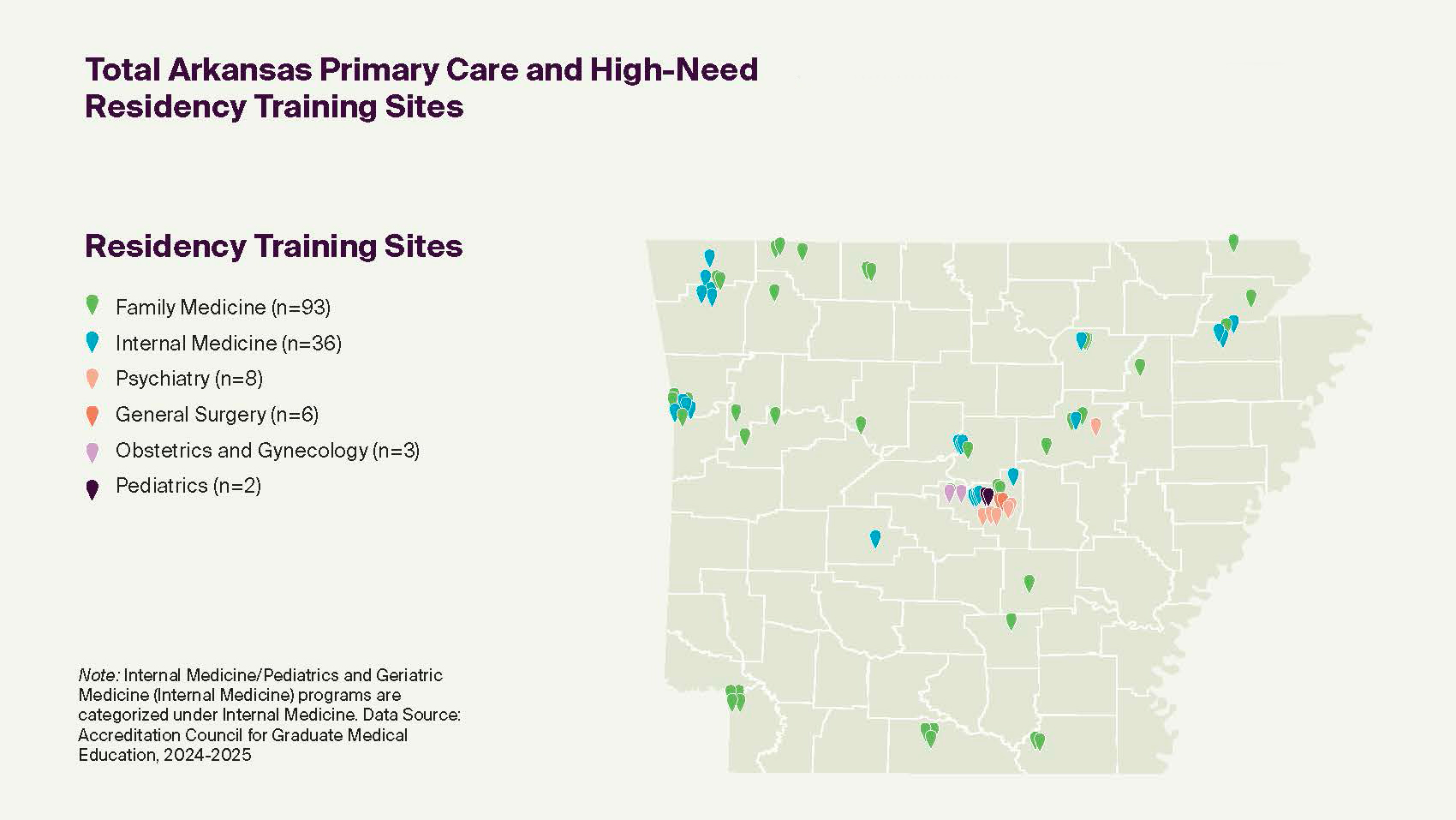
While Arkansas has built a meaningful training base, with 1,281 total ACGME‑accredited residency and fellowship positions statewide, financing and distribution constraints limit the state’s ability to translate that capacity into sustained residency growth. Fragmented funding and federal caps restrict expansion even where need and infrastructure exist.
A high‑return opportunity
The report estimates that a full statewide expansion of up to 500 residency positions could generate approximately $705 million in economic activity and deliver a return on investment exceeding 4:1, as resident physicians support local jobs, strengthen hospitals and clinics, and contribute to housing, services, and small businesses in the communities where they train and practice.
Arkansas already retains 58% of physicians who complete residency training in‑state — among the highest rates in the country — with most practicing within 100 miles of where they train.
“No other physician workforce investment delivers this level of long‑term recruitment and retention return on investment,” Bemis said. “Residency expansion is one of the most effective ways to improve access to care for communities across Arkansas.”
Grounded in statewide input
The report reflects a statewide research effort using mixed methods, including a statewide needs assessment, more than 30 interviews and listening sessions, and five regional forums involving more than 100 leaders and representatives from health systems, academic institutions, and community partners across the state.
The analysis examines training capacity, specialty and geographic gaps, and lessons from peer states that have successfully expanded residency training through coordinated approaches.
“Arkansas is well-positioned to expand its physician workforce by building on the strong foundation identified in the statewide GME strategy report,” said Lori Rodefeld, MS, Deputy Director, Sheps GME Technical Assistance Centers at University of North Carolina at Chapel Hill. “In other states, GME technical assistance centers have helped bring partners together, support new training programs, and sustain long-term growth. With a coordinated, statewide approach that leverages existing infrastructure and opportunities across regions, Arkansas can meaningfully expand training, strengthen its health care workforce, and improve access to care.”